Showing posts with label science. Show all posts

Saturday, September 27, 2014

Science

I was reading this book Questions, Questions by Marcus Pfister and it lead into the wondering question... 


Who teaches butterflies to fly?

As a group, we talked about what a wonder question is and how in kindergarten, we hope to think about questions we may not know the answer to. During meeting time, we record some of our thinking. The following day, we returned to this question to think some more and share our thoughts. One child was thrilled to share that she knew the answer. She looked it up on Google with her mom. 


Before letting her share the answer, we talked some more about How Butterflies learn to fly? My emphasis was not on getting the correct answer, but listening and sharing with one another.  Some student thought the mom butterfly teaches the butterfly to fly, but another child posed the question what if the butterfly is a widow? Do butterflies have a mom and dad?


How do butterflies learn to fly? 

They learn by watching.


Science Concept Books 

These Science Clever Concept books are BEAUTIFUL and loaded with rich vocabulary words. They are very expensive, so check your local library to see if they carry them. I plan to use these books to create a word chart for my Science area.


For my first lesson, my class read
 Cold, Crunchy and Colorful Using Our Senses.
Before reading, we talked about our five senses.

We were on the look out for 
color words
shape words
size words 
and 
texture words

Many children in my class were unfamiliar with the word texture, so this was a great introduction to that vocabulary word. I look forward to sharing more of these books with my class. 

Wednesday, July 24, 2013

Science Word Cards


In the spring of last year, I blogged about a science time in my class when my students would go outside and become a scientist. I called, this time,  BATES BACKYARD. With the help of my science curriculum specialist, we introduced the kids to Science Notebooks. You can see below that the notebooks are composition books bought at Staples, the paper inside is graph.  The students have plenty of space to record data, take notes and make scientific illustrations. You can click here to read a post about notebooks.


I read a few books to help me with my thinking about science in the primary class and using science notebooks. I found two great resources  Writing in Science in Action by Betsy Rupp Fulwiler and Starting With Science by Marcia Talhem Edson. 

One of the things in Writing in Science wrote about was using a writing frame or structure for students to refer to as they do their writing. I decided to make a table Science Word Cards. This way each student could have their own.

Writing Frame
I plan to let the students illustrate or
glue things in the empty boxes. For
example,  for shiny, we could glue a piece of tin foil.


Saturday, May 4, 2013

Science Notebooks


 I have blogged a few times about how I have started using Science Notebooks in my classroom. Here are some of the things we have been investigating and recording in our notebooks. 

Grass Investigation

I observed_______.
I noticed________.

This was a simple planting lesson. We planted grass seeds in clear cups. The kids loved seeing how the grass is growing in the middle of the cup with white roots.


 I observed some are long, and some are short.
 I observed it has a little part of the grass, and it has some roots.
Bates Backyard
Finding something to explore in our school yard.
This  Circle Map with a Rock in the center

milky white
black
bumpy
gray
flat
smooth

chalk rock
I noticed it could be a fairy raft.
It had lots of holes. 
It is a raft for a fairy.
Living Things
For this session, the children had to find a living thing in our backyard. You can click below to hear some comments.

Sunday, March 31, 2013

Science Notebooks

I was having a conversation with my Science Curriculum Specialist, and we were talking about Science notebooks. She was encouraging me to shift away from my science journal (with a pre-made template) and move into Science Notebooks. 

Over the course of a few weeks, she sent me some samples she had. I know in the Tony Stead book, he refers a lot to having students take notes in their notebooks. 

I was thinking...this Science notebook could be used for both.

What to Put in the Science Notebook?

At first, I asked Jany (my Science Specialist) to give me ideas for what the kids to look at. 

My thought was that I wanted it to be something easy. My class does observations on food jars, a tree on the playground and snails. Jany came up with the idea of just taking my class outside for fifteen minutes(each week) and letting them decided. She reminded me that kids are natural Scientist. 


Why not allow them to take charge and make decisions?


Some fairies live in pine cones.
Pine cones have sap.


Going Outside
I decided to call this time Bates Backyard time.
 I kept putting this off due to snow and finally on Friday we did it! 

We found a small spot on the playground. 
acorn top

Becoming Scientist
We looked around for an object/observation.
What would we wonder about?
What would we find? 
You could bring in your item, but it may be something that cannot come inside. We could take a picture of your item.
Be ready to share and record your observation. 

My class loved looking at all the items. We put them on a tray to look at. 

Reflection
Collecting objects from nature was simple, and the kids LOVED it. My next step is to find some books to read that connect to some of the objects that the children found. For example, I had a lot of kids bring in rocks so this week I plan to read some rock books.

When the kids were sharing their items, we focused on using describing words. 

We also shared wonder questions. 

I recently found this AMAZING site that has a wonder question each day called WONDEROPOLIS. Looking at some of the wonder questions on this site has helped my classroom start creating their wonder questions.  

Below is our first Bates Backyard time. 

Enjoy your Sunday! It is finally becoming warm in cold, snowy New England! 


simplebooklet.com

Wednesday, July 11, 2012

Science Journals and Science Ideas


Last summer I took a Science Class and left feeling excited about teaching Science. I worked on these Science journals, and when I went to use them in the fall, they were a flop! The journal was too confusing for kindergarten, especially for the fall.  So this summer I worked on a simpler version. I made boxes that students could write or draw in.

 In my school district, we teach kindergartens about water and habits. These are set units taught in a chunk of time during the year. I would love to use these journals to incorporate science on a daily basis.
I loved reading about how Jonelle uses her Science Notebooks!

  If you have any suggestion on how you use Science journals, I would love to hear from you!


The other thing that I want to do is have a 
Wonder of The Week
This comes from the amazing book

This kindergarten teacher designated a center in her classroom where the children could think about and respond to a posted question during center time or free time during the day. During the week, children wrote their explanations on a chart below the question. At the end of the week, the teacher set aside "pondering time" where the class participated in "shared research" and could discuss, research, and write about their ideas on a particular question. An example in the book from a child was: "How is money made?"


Incorporate Thinking Maps Into the Classroom Routines

Last month I took a Thinking Maps class and the instructor shared this great idea, the Bubble Bag.

The outside of the bags has adjectives describing the mystery object inside. This would be an excellent way to introduce describing words to kindergartners. You can see the clues on the outside of the bag.  The mystery item was a paper clip. 

Saturday, March 3, 2012

Nonfiction Text Features

We have been connecting creatures from Eric Carle's books to nonfiction texts.  I can see a huge increase in the interest of nonfiction books. A few students are starting to write about nonfiction topics at writing time.  I saw so many great nonfiction convention charts on Pinterest that I was inspired to create an anchor chart and have the students make little non-fiction convention books!


You can find a small kindergarten version and  a bigger version below. I decided that for the little k book I would write the definition, and I focused on six features.  The bigger book has more features and space for the student to write the definition. I zoomed in on a feature over a few days.


The finished Anchor Chart


Now, when we are reading nonfiction books we refer to the chart to reinforce the feature we learned about and why it is helpful.   You can find the download to the books and the chart below. Looking back, I will probably start this chart in the fall and focus on a feature once a week. Next week, we plan to create a Venn diagram comparing fiction and nonfiction.

Label

Close-Up

Photograph

I printed nonfiction photo's and had them cut and glue them in.


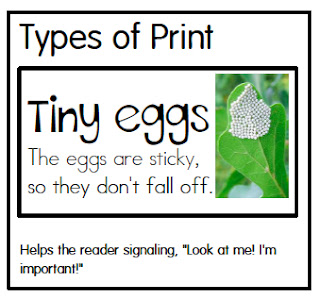
Types of Print

Comparisons
This picture is an ant next to an orange.

Types of Print

Map
We read the story Me on a Map and I encouraged students to make a map of the classroom or their bedroom.


Download All Pages Together 


labels and photographs
Maps and Close-ups 
Types of Prints and Comparisons


This book has a Table of Contents, Index, Glossary and Captions.


You can download individual pages.

labels

Photographs

Close-ups

Cutaway

Maps

Table of Contents

Types of Print
comparisons
for glossary and index I cut and pasted images from real books and a photocopied
Glossary
Index 


The Inspiration came from this beautiful chart on Pinterest! 
LOVE LOVE LOVE

Wednesday, January 18, 2012

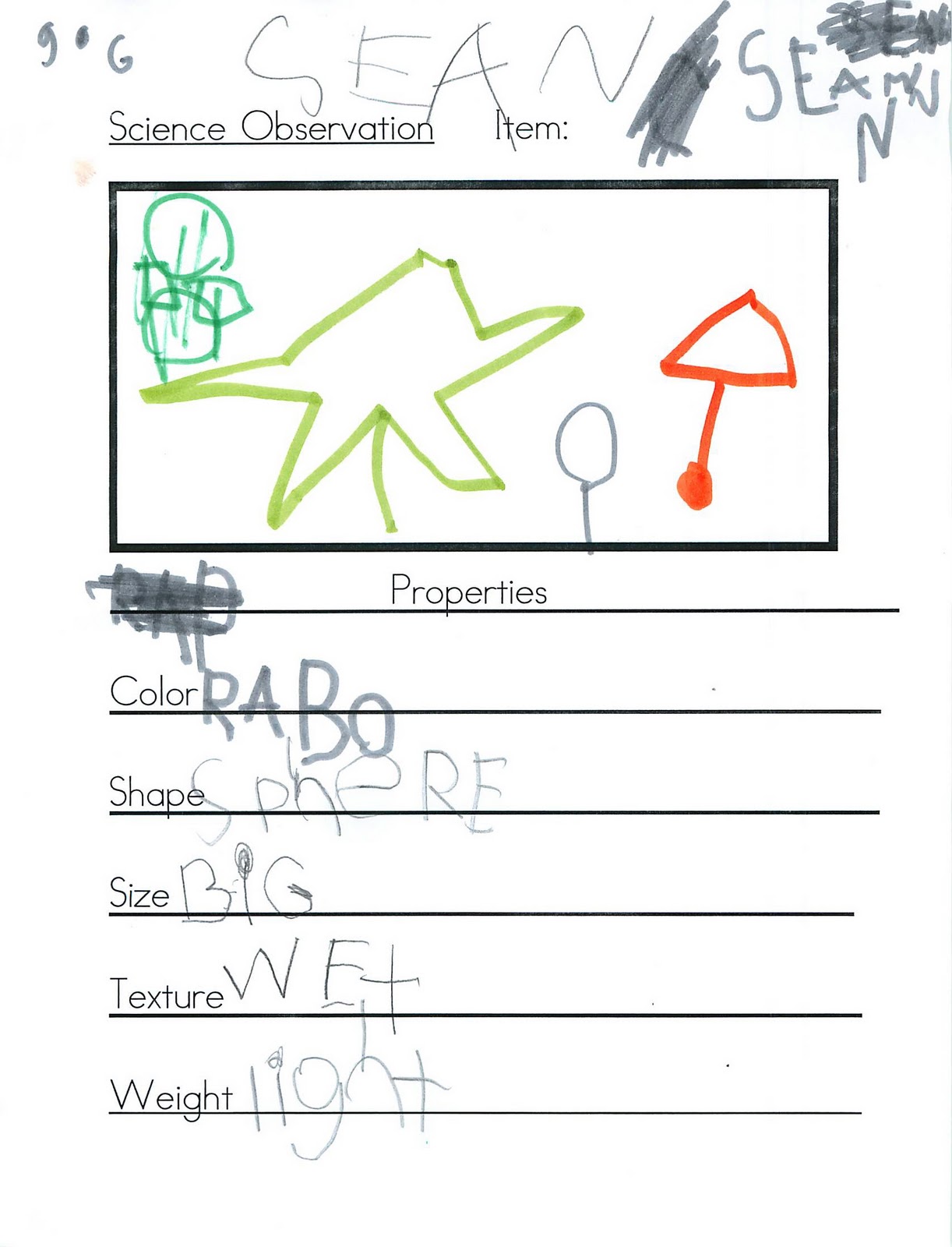
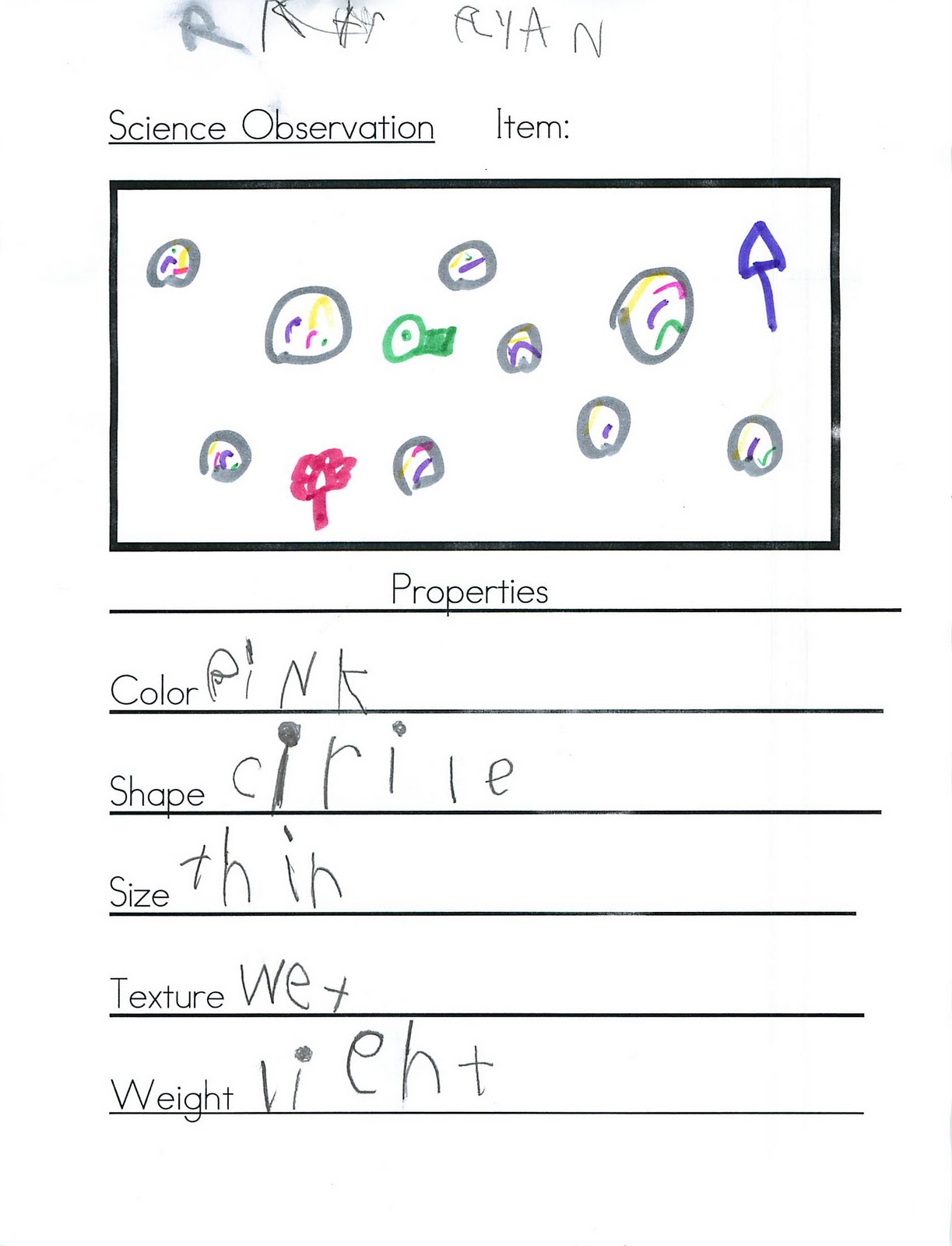
Science Observation Sheet

To follow up from our science investigation yesterday, we filled in this observation sheet. When filling in their observation sheets, they can refer to the chart above.  We use this chart for many different classroom observation or recording parts of a scientific research.


I find this recording sheet perfect for kindergarten. 
The item recorded was bubbles.

The sheet is available for download below!


Bubble Observations.cwk (WP)
Related Posts Plugin for WordPress, Blogger...